三种通用竞争战略

企业如何在行业中获得持久的竞争优势?波特给出的答案是:企业必须选择并坚定执行三种通用战略(总低成本、差异化、聚焦)中的一种,战略模糊、摇摆不定,几乎必然导致低于行业平均水平的盈利能力。
1、第一章将竞争战略描述为:通过采取进攻性或防御性行动,在行业中建立一个可坚守的地位,成功应对五种竞争力,从而为企业带来超额的投资回报。企业为实现这一目标采取过许多不同的做法,而对某一特定企业而言,最佳战略最终是反映其自身具体情况进行独特构建。Chapter 1 described competitive strategy as taking offensive or defensive actions to create a defendable position in an industry, to cope successfully with the five competitive forces and thereby yield a superior return on investment for the firm. Firms have discovered many different approaches to this end, and the best strategy for a given firm is ultimately a unique construction reflecting its particular circumstances. However, at the broadest level we can identify three internally consistent generic strategies (which can be used singly or in combination) for creating such a defendable position in the long run and outperforming competitors in an industry. This chapter describes the generic strategies and explores some of the requirements and risks of each. Its purpose is to develop some introductory concepts that can be built upon in subsequent analysis. Succeeding chapters of this book will have much more to say about how to translate these broad generic strategies into more specific strategies in particular kinds of industry situations.
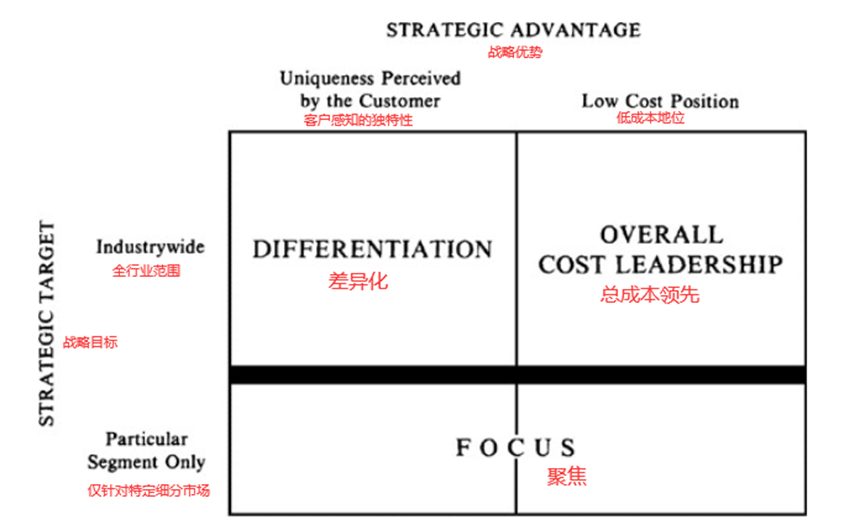
2、在应对五种竞争力时,有三种可能成功的通用战略路径,可使企业在行业中超越其他公司:总成本领先;差异化;聚焦。In coping with the five competitive forces, there are three potentially successful generic strategic approaches to outperforming other firms in an industry:1. overall cost leadership2. differentiation3. focus.
3、企业有时可以同时成功推行不止一种路径作为主要目标,尽管正如后文将要进一步讨论的,尽管这种情况极少可能实现。有效实施上述任何一种通用战略,通常都需要全身心投入以及配套的组织安排;若同时存在多个主要目标,这些安排就会被削弱。通用战略是在行业中超越竞争对手的路径;在某些行业结构下,所有企业都能获得高回报;而在另一些行业中,企业可能必须成功实施某一种通用战略,才能从绝对意义上获得尚可接受的回报。Sometimes the firm can successfully pursue more than one approach as its primary target, though this is rarely possible as will be discussed further. Effectively implementing any of these generic strategies usually requires total commitment and supporting organizational arrangements that are diluted if there is more than one primary target. The generic strategies are approaches to outperforming competitors in the industry; in some industries structure will mean that all firms can earn high returns, whereas in others, success with one of the generic strategies may be necessary just to obtain acceptable returns in an absolute sense.
4、成本领先要求企业积极构建高效规模的生产设施,大力通过经验积累降低成本,严格控制成本与管理费用,放弃边际效益较低的客户业务,并在研发、服务、销售团队、广告等领域尽可能最小化成本。要实现这些目标,管理层必须对成本控制给予高度关注。相对于竞争对手的低成本,是贯穿整个战略的核心主题,尽管质量、服务及其他领域也不能被忽视。The first strategy, an increasingly common one in the 1970s because of popularization of the experience curve concept, is to achieve overall cost leadership in an industry through a set of functional policies aimed at this basic objective. Cost leadership requires aggressive construction of efficient-scale facilities, vigorous pursuit of cost reductions from experience, tight cost and overhead control, avoidance of marginal customer accounts, and cost minimization in areas like R&D, service, sales force, advertising, and so on. A great deal of managerial attention to cost control is necessary to achieve these aims. Low cost relative to competitors becomes the theme running through the entire strategy, though quality, service, and other areas cannot be ignored.
5、拥有低成本地位,即便行业中存在强大的竞争力量,企业仍能在行业内获得高于平均水平的收益。其成本地位为企业构筑了抵御同行竞争的防线:因为更低的成本意味着,当竞争对手通过相互竞争耗尽利润之后,企业依然能够实现盈利。因此,低成本地位能够抵御全部五种竞争力:议价行为只会持续侵蚀利润,直到效率次优的竞争对手无利可图;而在竞争压力下,效率更低的对手会先遭受损失。Having a low-cost position yields the firm above-average returns in its industry despite the presence of strong competitive forces. Its cost position gives the firm a defense against rivalry from competitors, because its lower costs mean that it can still earn returns after its competitors have competed away their profits through rivalry. A low-cost position defends the firm against powerful buyers because buyers can exert power only to drive down prices to the level of the next most efficient competitor. Low cost provides a defense against powerful suppliers by providing more flexibility to cope with input cost increases. The factors that lead to a low-cost position usually also provide substantial entry barriers in terms of scale economies or cost advantages. Finally, a low-cost position usually places the firm in a favorable position vis-à-vis substitutes relative to its competitors in the industry. Thus a low-cost position protects the firm against all five competitive forces because bargaining can only continue to erode profits until those of the next most efficient competitor are eliminated, and because the less efficient competitors will suffer first in the face of competitive pressures.
6、实现整体低成本地位,通常需要企业具备较高的相对市场份额或其他优势,例如便捷的原材料采购渠道。这往往还要求:产品设计便于生产制造、推出种类丰富的相关产品线以分摊成本、服务所有主要客户群体以扩大产销规模。相应地,实施低成本战略可能需要:前期投入大量资金购置先进设备,采取积极定价策略,并在起步阶段为建立市场份额承担初期亏损。而较高的市场份额又可以带来采购环节的规模效应,从而进一步降低成本。低成本地位一旦实现,企业就能获得较高的利润空间,并将这些利润可再投资于新设备与现代化设施,以维持成本领先地位。这类再投资往往是持续保持低成本地位的必要前提。
Achieving a low overall cost position often requires a high relative market share or other advantages, such as favorable access to raw materials. It may well require designing products for ease in manufacturing, maintaining a wide line of related products to spread costs, and serving all major customer groups in order to build volume. In turn, implementing the low-cost strategy may require heavy up-front capital investment in state-of-the art equipment, aggressive pricing, and start-up losses to build market share. High market share may in turn allow economies in purchasing which lower costs even further. Once achieved, the low-cost position provides high margins which can be reinvested in new equipment and modern facilities in order to maintain cost leadership. Such reinvestment may well be a prerequisite to sustaining a low-cost position.
7、成本领先战略有时可以彻底重塑一个行业,尤其是在那些竞争格局长期固化、而竞争对手无论在认知或经济层面都未做好充分准备、难以采取必要措施实现成本最小化的领域。A cost leadership strategy can sometimes revolutionize an industry in which the historical bases of competition have been otherwise and competitors are ill-prepared either perceptually or economically to take the steps necessary for cost minimization. Harnischfeger is in the midst of a daring attempt to revolutionize the rough-terrain crane industry in 1979. Starting from a 15 percent market share, Harnischfeger redesigned its cranes for easy manufacture and service using modularized components, configuration changes, and reduced material content. It then established subassembly areas and a conveyorized assembly line, a notable departure from industry norms. It ordered parts in large volumes to save costs. All this allowed the company to offer an acceptable quality product and drop prices by 15 percent. Harnischfeger’s market share has grown rapidly to 25 percent and is continuing to grow. Says Willis Fisher, general manager of Harnischfeger’s Hydraulic Equipment Division:
8、第二种通用战略是即对企业提供的产品或服务实行差异化,创造出在全行业范围内被视为独具特色的东西。实现差异化的方式多种多样:设计或品牌形象(高端毛巾与家纺领域的菲尔德克雷斯特;汽车领域的梅赛德斯);技术(叉车领域的海斯特;音响组件的麦金托什;露营装备的科尔曼);产品功能(电炉领域的珍安空气);客户服务(金属罐领域的皇冠瓶盖与密封公司);经销商网络(工程机械设备领域的卡特彼勒);或其他维度。理想情况下,企业会在多个维度同时实现差异化。需要强调的是,差异化战略并不意味着企业可以忽视成本,只不过成本并非其首要战略目标。
The second generic strategy is one of differentiating the product or service offering of the firm, creating something that is perceived industrywide as being unique. Approaches to differentiating can take many forms: design or brand image (Fieldcrest in top of the line towels and linens; Mercedes in automobiles), technology (Hyster in lift trucks; MacIntosh in stereo components; Coleman in camping equipment), features (Jenn-Air in electric ranges); customer service (Crown Cork and Seal in metal cans), dealer network (Caterpillar Tractor in construction equipment), or other dimensions. Ideally, the firm differentiates itself along several dimensions. Caterpillar Tractor, for example, is known not only for its dealer network and excellent spare parts availability but also for its extremely high-quality durable products, all of which are crucial in heavy equipment where downtime is very expensive. It should be stressed that the differentiation strategy does not allow the firm to ignore costs, but rather they are not the primary strategic target.
9、差异化战略一旦成功实现,便是企业在行业中获取超额收益的一种可行战略,因为它能为企业建立起应对五种竞争力的可防御地位,尽管其作用方式与成本领先战略有所不同。差异化借助客户的品牌忠诚度、以及由此带来的更低价格敏感度,使企业能够抵御同业竞争的冲击。它同时能提高利润率,从而让企业不必追求低成本地位。由此形成的客户忠诚度,以及竞争对手必须克服独特性的门槛,共同构成了行业进入壁垒。差异化带来的更高利润率,有助于企业应对供应商的议价能力;同时也能显著削弱买方的议价能力,因为买方缺乏可替代的选择,对价格也就不那么敏感。最后,通过差异化赢得客户忠诚度的企业,在面对替代品时,通常会比竞争对手处于更有利的地位。Differentiation, if achieved, is a viable strategy for earning above-average returns in an industry because it creates a defensible position for coping with the five competitive forces, albeit in a different way than cost leadership. Differentiation provides insulation against competitive rivalry because of brand loyalty by customers and resulting lower sensitivity to price. It also increases margins, which avoids the need for a low-cost position. The resulting customer loyalty and the need for a competitor to overcome uniqueness provide entry barriers. Differentiation yields higher margins with which to deal with supplier power, and it clearly mitigates buyer power, since buyers lack comparable alternatives and are thereby less price sensitive. Finally, the firm that has differentiated itself to achieve customer loyalty should be better positioned vis-à-vis substitutes than its competitors.
10、实现差异化有时会妨碍企业获得高市场份额。差异化往往需要营造一种专属稀缺感,而这与高市场份额本身是相互矛盾的。Achieving differentiation may sometimes preclude gaining a high market share. It often requires a perception of exclusivity, which is incompatible with high market share. More commonly, however, achieving differentiation will imply a trade-off with cost position if the activities required in creating it are inherently costly, such as extensive research, product design, high quality materials, or intensive customer support. Whereas customers industrywide acknowledge the superiority of the firm, not all customers will be willing or able to pay the required higher prices (though most are in industries like earthmoving equipment where despite high prices Caterpillar has a dominant market share). In other businesses, differentiation may not be incompatible with relatively low costs and comparable prices to those of competitors.
11、第三种通用战略是聚焦战略,即企业将目标专注于某一特定客户群体、某一产品线细分市场或某一区域市场;与差异化战略一样,聚焦战略也可以有多种实现形式。尽管成本领先和差异化战略旨在全行业范围内实现目标,但聚焦战略的核心则是围绕某一特定目标群体提供极致服务,企业的各项职能政策均以此为出发点进行设计。该战略的基本前提是:与经营范围更广泛的竞争对手企业相比,本企业能够更有效、更高效地服务于这个狭窄的战略目标市场。因此,企业可以通过两种方式建立优势:要么通过更好地满足特定目标的需求从而实现差异化,要么在服务该目标时实现更低成本,或两者兼具。The final generic strategy is focusing on a particular buyer group, segment of the product line, or geographic market; as with differentiation, focus may take many forms. Although the low cost and differentiation strategies are aimed at achieving their objectives industrywide, the entire focus strategy is built around serving a particular target very well, and each functional policy is developed with this in mind. The strategy rests on the premise that the firm is thus able to serve its narrow strategic target more effectively or efficiently than competitors who are competing more broadly. As a result, the firm achieves either differentiation from better meeting the needs of the particular target, or lower costs in serving this target, or both. Even though the focus strategy does not achieve low cost or differentiation from the perspective of the market as a whole, it does achieve one or both of these positions vis-à-vis its narrow market target. The difference among the three generic strategies are illustrated in figure 2-1.
12、实施聚焦战略的企业同样有可能在行业内获得高于平均水平的收益。这种聚焦意味着企业在其战略目标市场上,要么拥有低成本地位,要么实现高度差异化,或是两者兼具。The firm achieving focus may also potentially earn above-average returns for its industry. Its focus means that the firm either has a low cost position with its strategic target, high differentiation, or both. As we have discussed in the context of cost leadership and differentiation, these positions provide defenses against each competitive force. Focus may also be used to select targets least vulnerable to substitutes or where competitors are the weakest.
13、聚焦战略必然要求在盈利能力与销售规模之间做出权衡。The focus strategy always implies some limitations on the overall market share achievable. Focus necessarily involves a trade-off between profitability and sales volume. Like the differentiate strategy, it may or may not involve a trade-off with overall cost position.
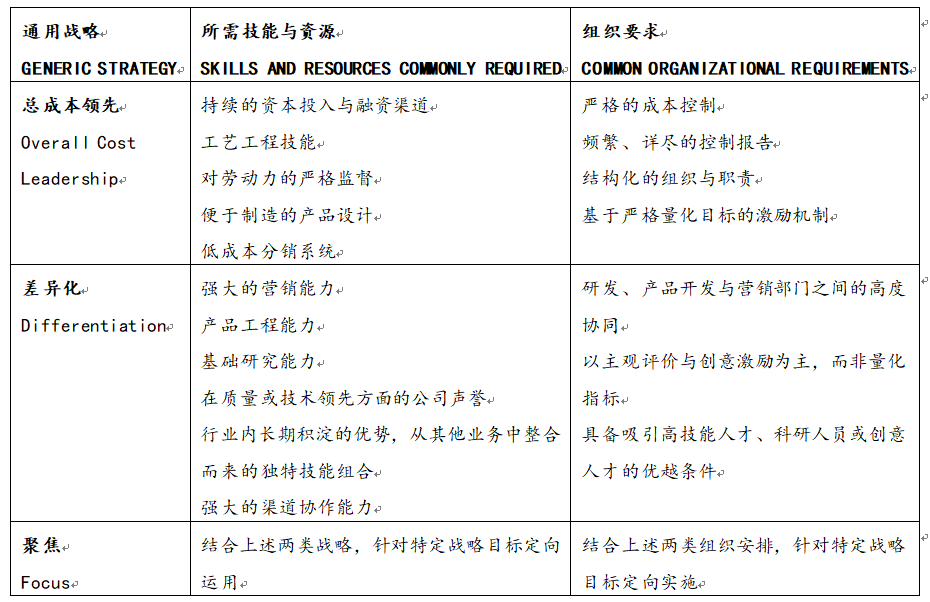
14、成功实施这些战略需要不同的资源与能力,同时也意味着在组织安排、管控流程以及激励制度上要采取不同的模式。因此,企业必须持续专注于其中一种战略作为核心目标、并坚定执行,才能取得成功。The three generic strategies differ in dimensions other than the functional differences noted above. Implementing them successfully requires different resources and skills. The generic strategies also imply differing organizational arrangements, control procedures, and inventive systems. As a result, sustained commitment to one of the strategies as the primary target is usually necessary to achieve success. Some common implications of the generic strategies in these areas are as follows:
15、这些通用战略往往也需要不同的领导风格,并最终会塑造出截然不同的企业文化与氛围,进而吸引不同类型的人才加入。The generic strategies may also require different styles of leadership and can translate into very different corporate cultures and atmospheres. Different sorts of people will be attracted.
16、若企业未能沿着这三个方向中的至少一个来制定发展战略——即陷入“两难困境”的企业——其战略处境将极为不利。The three generic strategies are alternative, viable approaches to dealing with the competitive forces. The converse of the previous discussion is that the firm failing to develop its strategy in at least one of the three directions -a firm that is “stuck in the middle”-is in an extremely poor strategic situation. This firm lacks the market share, capital investment, and resolve to play the low-cost game, the industrywide differentiation necessary to obviate the need for a low-cost position, or the focus to create differentiation or a low-cost position in a more limited sphere.
17、陷入两难困境的企业几乎注定只能获得低水平的盈利能力。The firm stuck in the middle is almost guaranteed low profitability. It either loses the high-volume customers who demand low prices or must bid away its profits to get this business away from low-cost firms. Yet it also loses high-margin businesses-the cream-to the firms who are focused on high-margin targets or have achieved differentiation overall. The firm stuck in the middle also probably suffers from a blurred corporate culture and a conflicting set of organizational arrangements and motivation system.
18、陷入两难困境的企业必须做出根本性的战略抉择。The firm stuck in the middle must make a fundamental strategic decision. Either it must take the steps necessary to achieve cost leadership or at least cost parity, which usually involve aggressive investments to modernize and perhaps the necessity to buy market share, or it must orient itself to a particular target (focus) or achieve some uniqueness (differentiation). The latter two options may well involve shrinking in market share and even in absolute sales. The choice among these options is necessarily based on the firm’s capabilities and limitations. Successfully executing each generic strategy involves different resources, strengths, organizational arrangements, and managerial style, as has been discussed. Rarely is a firm suited for all three.
19、企业一旦陷入两难困境,通常需要长期时间与持续努力才能摆脱这一不利局面。然而,陷入困境的企业似乎往往存在一种倾向:随着时间推移,在三种通用战略之间摇摆不定、反复切换。考虑到同时追求这三种战略可能存在的内在矛盾,这种做法几乎注定会失败。Once stuck in the middle, it usually takes time and sustained effort to extricate the firm from this unenviable position. Yet there seems to be a tendency for firms in difficulty to flip back and forth over time among the generic strategies. Given the potential inconsistencies involved in pursuing these three strategies, such an approach is almost always doomed to failure.
20、这些理论提示了市场份额与盈利能力之间可能存在多种关系。在某些行业中,陷入两难困境的问题意味着:规模较小的企业(采用聚焦或差异化战略)与规模最大的企业(采用成本领先战略)盈利能力最强,而中等规模企业盈利能力最弱。这意味着盈利能力与市场份额之间呈现U型关系。These concepts suggest a number of possible relationships between market share and profitability. In some industries, the problem of getting caught in the middle may mean that the smaller (focused or differentiated) firms and the largest (cost leadership) firms are the most profitable, and the medium-sized firms are the least profitable. This implies a U-shaped relationship between profitability and market share. The relationship appears to hold in the U.S. fractional horsepower electric motor business. There GE and Emerson have large market shares and strong cost positions, GE also having a strong technological reputation. Both are believed to earn high returns in motors. Baldor and Gould (Century) have adopted focused strategies, Baldor oriented toward the distributor channel and Gould toward particular customer segments. The profitability of both is also believed to be good. Franklin is in an intermediate position, with neither low cost nor focus. Its performance in motors is believed to follow accordingly. Such a U-shaped relationship probably also roughly holds in the automobile industry when viewed on a global basis, with firms like GM (low cost) and Mercedes (differentiate) the profit leaders. Chrysler, British Leyland, and Fiat lack cost position, differentiation, or focus-they are stuck in the middle.
21、图2-2中的U型关系并非在所有行业都成立。在部分行业中,企业没有实施聚焦或差异化战略的空间机会——竞争纯粹是一场成本博弈,许多大宗商品行业便是如此。在另一些行业中,由于客户和产品特性,成本因素相对不重要。这类行业中,市场份额与盈利能力之间往往呈现反向关系。还有一些行业的竞争异常激烈,企业获取超额收益的唯一途径只能是通过聚焦或差异化——美国钢铁行业便属于这种情况。最后,整体低成本地位未必与差异化或聚焦战略互斥,或者企业不需要依靠高市场份额也能实现低成本。However, the U-shaped relationship does not hold in every industry. In some industries, there are no opportunities for focus or differentiation-it’s solely a cost game-and this is true in a number of bulk commodities. In other industries, cost is relatively unimportant because of buyer and product characteristics. In these kinds of industries there is often an inverse relationship between market share and profitability. In still other industries, competition is so intense that the only way to achieve an above-average return is through focus or differentiation-which seems to be true in the U.S. steel industry. Finally, low overall cost position may not be incompatible with differentiation or focus, or low cost may be achievable without high share. For an example of the complex combinations that can result, Hyster is number two in lift trucks but is more profitable than several of the smaller producers in the industry (Allis-Chalmers, Eaton) who do not have the share to achieve either low costs or enough product differentiation to offset their cost position.
22、盈利能力与市场份额之间并不存在单一的固定关系。There is no single relationship between profitability and market share, unless one conveniently defines the market so that focused or differentiated firms are assigned high market shares in some narrowly defined industries and the industry definitions of cost leadership firms are allowed to stay broad (they must because cost leaders often do not have the largest share in every submarket). Even shifting industry definition cannot explain the high returns of firms who have achieved differentiation industrywide and hold market shares below that of the industry leader.
23、企业究竟该选择三种通用战略中的哪一种才适合自身。这一选择取决于挑选最适合企业自身优势、且竞争对手最难复制的战略。结构分析的原理应当能够指导这一选择,并帮助分析者解释或预测特定行业中市场份额与盈利能力之间的关系。Most importantly, however, shifting the way the industry is defined from firm to firm begs the question of deciding which of the three generic strategies is appropriate for the firm. This choice rests on picking the strategy best suited to the firm’s strengths and one least replicable by competitors. The principles of structural analysis should illuminate the choice, as well as allow the analyst to explain or predict the relationship between share and profitability in any particular industry. I will discuss this issue further in Chapter 7, where structural analysis is extended to consider the differing positions of firms within a particular industry.